- Withdrawal Force
See " Extraction Force"
- Double Action
A spring pin that is manufactured with two plunger components, allowing for actuation on both sides of the product. These plungers share the same internal spring, so the travel distance is cumulative between both components. This type of product is an appealing solution for applications that require either a temporary or permanent connection between two parallel boards or devices without the use of solder. View examples.
- Cycle
One complete mating sequence between two interconnect components. A cycle between a pin and receptacle combination refers to one full insertion and extraction of the pin into the contact clip of the receptacle.

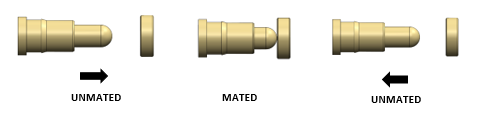
One Pin/Receptacle Cycle A cycle between a spring pin and target pin/pad combination refers to one compression of the plunger onto a target, typically to half-stroke, followed by a return to the uncompressed state
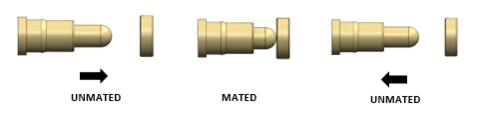
One Spring-Loaded Compression/Cycle

- Current Rating
Current carrying capability of a product measured in amperes with respect to a specific temperature rise. For Mill-Max products, the current rating has been specified with a conservative 10°C temperature rise (Tested at room temperature, 20˚ C). The current rating advertised for a product can be found on the specific product’s webpage on our website. Please note that this performance characteristic is not specified for male pins and male pin headers. Theoretically, the amount of current that can be passed through a male pin can be increased until the heat generated reaches the melting temperature of the pin material. In practice this is limited by other elements in the circuit such as the PCB, the mating receptacle or socket and active components. To evaluate the heat generated in a pin due to an applied current, the resistance of the pin is required. The formula below can be used to calculate the resistance (in ohms) of a pin. The table below provides the resistivity values for the materials Mill-Max uses along with thermal properties that may be useful for further heating calculations.
R=(ρ*L)/A: where R is resistance; ρ is electrical resistivity of the material; L is the length in feet and A is the area in circular mils.
Material
Resistivity (ρ) ohms
(circ mil/ft) @68˚F
Thermal Conductivity
(Btu/sq ft/ft hr/˚F @68˚F)
Thermal Capacity
(Btu/lb/˚F @68˚F)
Brass 360 & Brass 385
37-40
67
.09
Phosphor Bronze Alloy 544
54.6
50
.09
Tellurium Copper Alloy 145
11.2
205
.092
- Bi-furcated
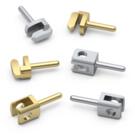
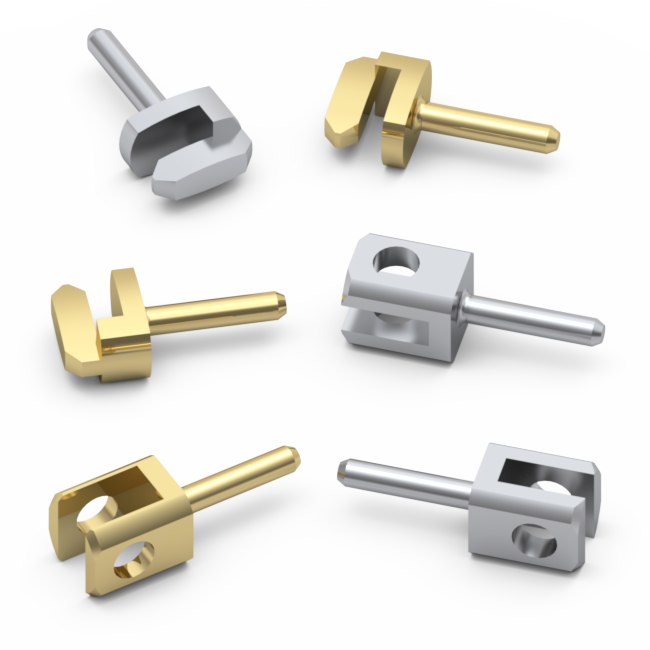
A horizontal slotted feature intended for edge mounting. The location of the slot lends itself to being utilized in applications requiring parallel board mounting.
This feature is also machined with two flats, allowing the component to be partially press-fit into the board prior to soldering. Learn More
- PCB Connectors
PCB Connectors can be referred to as PCB Interconnects or Rectangular Connectors. Specific terms are also used for the two sides of the connection. Male PCB Connectors are often referred to as Pin Headers, as they are simply rows of pins. Female PCB Connectors can be called Sockets, Receptacles, or Socket Headers.
- Carrier/Transporter
An assembly consisting of an insulator with male dummy pins onto which discrete receptacles are loaded. This assembly is employed as a fixture during a soldering operation and is subsequently removed leaving a PC board populated with individual receptacles. Carriers that load male pins are also available for special applications as custom/made to order solutions. Learn More.
- Closed Bottom
A type of receptacle whose body is closed or sealed on the side opposite the contact clip. This allows the mating pin or lead inserted to “bottom out”, meaning that it is inserted to the point where it is contacting the bottom surface. While this has no bearing on the performance of the product, “bottoming out” does provide the user a simple method of determining whether the receptacle is completely capturing the mating lead. A closed bottom part also eliminates the concern of solder wicking up the bottom of the part during soldering procedures such as wave or reflow. View Examples.
- Bottom Entry Receptacle
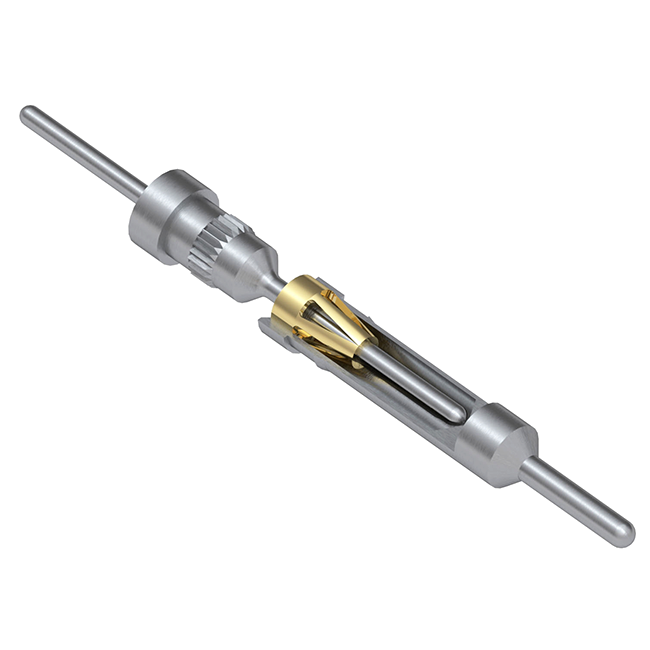
Typically, Mill-Max receptacles are assembled into a PCB with the contact clip towards the top of the board, and the mating lead being driven from the top-down. In bottom entry receptacles, the clip is loaded into the bottom end of the shell (side opposite the shoulder). When this style of receptacle is assembled into the board, the lead must be inserted upwards from the bottom of the board. View Examples.
- Barb
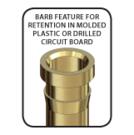
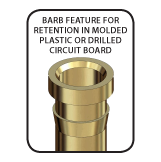
Sometimes referred to as a fish-hook, a barb is a common press-fit feature machined on many pins, receptacles, and spring pins. This feature is used predominately to retain products in non-plated through holes such as ones in insulators or plastic housings. A barb retains a product by ”biting” into the sides of the mounting hole during assembly, generating an interference fit between both components. Barbs do not offer any anti-rotation properties, so a knurl retention feature is often used instead when this is a firm requirement.