- Nylon 46
Classified as a thermoplastic, Nylon 46 offers superior heat resistance, good electrical properties and excellent toughness in its thin walls, which are desirable characteristics for connector insulators. Its superior strength in thin walls enables the press-fitting of pins in close proximity to each other without cracking or warping the material, making it ideal for molding 1mm, 2mm and .050" grid insulators. Nylon 46 is suitable for high temperature applications including vapor phase, infra-red reflow and wave soldering operations.
- Zinc Migration
A condition that exists when a brass part is plated with tin or gold. The migration of zinc from brass to the plating surface will create a zinc oxide layer which will render the part un-solderable. Zinc migration is prevented by using a copper or nickel as a barrier.
- Mating Pin
A pin or lead used to mate with a female interconnect component by inserting into the contact clip. Critical features of this component include the diameter, length, shape of the tail or shaft and the plating finish. There may be a termination feature on the opposite end of the mating lead depending on the specific application.
- Machined
Manufacturing process whereby a rapidly turning solid metal rod is cut to precise tolerances. This method lends itself to generating features commonly developed on a rotational axis, namely operations such as turning, facing, cutting, drilling, and knurling. Secondary processes allow for the implementation of more unconventional features, such as slots and/or backholes. Also known as .
- LCP (Liquid Crystal Polymer)
Classified as a thermoplastic, LCP is a hard, rigid material which exhibits outstanding strength at high temperatures and exceptional strength and toughness in its thin walls. Applications: LCP is used as an insulator material for tight grid (.050", 2mm) connectors and extremely high temperature requirements.
- Knurl
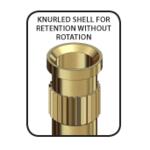
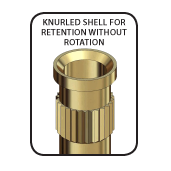
An array of vertical serrations machined around a diameter of an interconnect pin or receptacle, providing a retention feature for press-fitting into an unplated mounting hole in a PC board or insulator. This feature prevents the pin from rotating within the mounting hole, which may be beneficial in applications where alignment is critical. View Examples.
- Insertion Force
The force required to insert a mating pin or lead into a contact clip. The value of this force is primarily driven by factors such as the specific contact clip selected, the base material of the contact clip, and the shape and diameter of the mating lead. The force of the initial insertion will typically yield the greatest amount of force, as the mating lead is opening the fingers/tines of the contact for the first time. The insertion force is also typically greater in magnitude when compared to the same contact’s extraction force. Graphs illustrating the extraction forces for each contact clip can be found online or on the Receptacle Contact Data catalog pages.
- Injection Molding
A molding method whereby granular plastic is heated to a molten state and injected into a mold cavity. The plastic solidifies to the shape of the cavity upon cooling and is promptly ejected. Standard Mill-Max connectors use various injection-molded housings which are press-fitted with discrete components. Custom injection-molded housing designs can also be explored upon request.
- High Speed Turning
Also known as high speed machining, this manufacturing process uses rotating stock, cutting tools, and bits to create interconnect components such as pins, receptacles, and spring pins. This process allows for ultra-tight tolerances, smooth finishes, and unsurpassed quality. Learn More
- Hex Press Fit
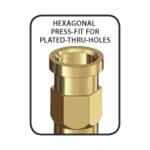
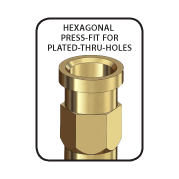
A hexagonal cross section machined around the body of a receptacle or pin providing a retention feature for press-fitting in a PC board with a Plated Through Hole. It can also prevent rotation of the pin, while still maintaining a Gas Tight Connection. View Examples.