
- Shrink DIP Package
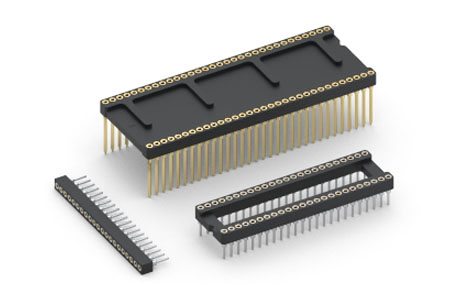
A DIP connector provided on .070" pitch/centers instead of the more common .100” spacing. These packages are useful in applications that require a DIP style connection but cannot afford the board space required for a standard .100” DIP. Learn More
- Secondary Machining
- A process in which back holes, slots, flats, squares or other special features may be machined onto a pin or receptacle after its basic shape has been turned on a high-speed lathe. Allows for more complex geometries in part designs that would be unfeasible with a singular machining process.
- Screw-Machined (Precision-Machined)
A manufacturing process whereby a rapidly turning solid metal rod is cut to precise tolerances by means of a high-speed swiss screw machine. This process allows for the development of machined pins with features that are held to great precision and accuracy, sometimes sporting machining tolerances of less than .001 of an inch. Learn More
- Receptacle
Sometimes referred to as PCB sockets, micro-plugs or connector jacks, machined pin receptacles are known for their reliability and versatility. The pin receptacle is a 2 piece female contact consisting of an outer shell and inner spring contact (clip) designed for multiple mating/unmating cycles with a male pin or component lead. Used discretely in a PC Board or in plastic as connector arrays, receptacles make devices and modules pluggable for repair and replacement. Learn More
- Precision-Machined (Screw-Machined)
A manufacturing process whereby a rapidly turning solid metal rod is cut to precise tolerances by means of a high-speed swiss screw machine. This process allows for the development of machined pins with features that are held to great precision and accuracy, sometimes sporting machining tolerances of less than .001 of an inch. Learn More
- Plating
A process by which metals (e.g. gold, tin-lead, nickel, silver) are electrically or chemically deposited onto a base metal in precise thicknesses. Multiple layers of plating can be applied over one another as part of an overall plating spec, usually dictated by industry standards.
- Plated Through-Hole (PTH)
A hole in a printed circuit board which has been plated with a layer of conductive metal over the interior walls. Provides an electrical connection to/from a component using a network of conductive pathways called “traces”. Components can be soldered or pressed in using an appropriate press-fit feature for a PTH (square, hex or pentagon style). View Examples
- PCT (Polycyclohexane Terephthalate)
Thermoplastic polyester is rated for higher temperatures. PCT is a standard material on DIP and SIP insulators for higher temperature operations. All PGA and surface mount products are molded from PCT and are suitable for infra-red, vapor phase and wave soldering.
- Printed Circuit Board (PCB)
A printed circuit board (PCB) mechanically supports and electrically connects electronic components using conductive tracks, pads and other features etched from one or more sheet layers of copper laminated onto and/or between sheet layers of a non-conductive substrate. Components are generally soldered onto the PCB to both electrically connect and mechanically fasten them to it.
- Passive Device or Component
An electronic connector that consumes electrical energy, but does not produce electrical energy. Passive devices are not susceptible to significant ESD damage.