01 SOLDERLESS
Mount without solder
Use polygon or compliant-tail press-fit features to create mechanical retention and an electrical path in a plated through-hole.

Precision machined interconnects
Choose from standard PCB pins or work with Mill-Max on an application-specific design. Tight-tolerance machining, multiple termination features and in-house plating help engineers solve electrical, mechanical and assembly challenges with one component.
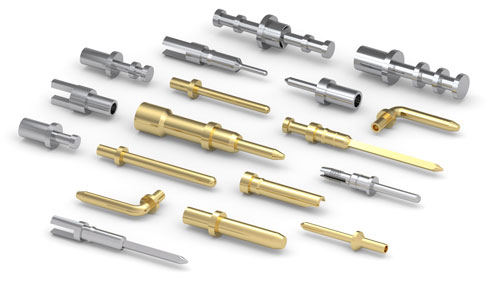
Mill-Max precision machined connector pins are conductive, mechanically robust building blocks for PCB, board-to-board, wire-to-board, component lead and custom interconnect designs. They can be configured with press-fit, swage, solder, crimp or wire-wrap features and paired with receptacles for pluggable connections.
Engineering range
Start with the connection method, mating interface and production process. Mill-Max can support a broad range of standard geometries and custom configurations.
Start with your requirement
01 SOLDERLESS
Use polygon or compliant-tail press-fit features to create mechanical retention and an electrical path in a plated through-hole.
02 BOARD + COMPONENT
Specify pin geometry for permanent or pluggable board-to-board connections, component leads, test points and low-profile assemblies.
03 WIRE TERMINATION
Choose solder cup, turret, wrapost or crimp features based on wire size, tooling, serviceability and production requirements.
04 CUSTOM DESIGN
Customize material, plating, diameters, shoulders, retention geometry, termination features and packaging for the application.
Why precision machining
A connector pin is more than a conductive path. Its geometry can also locate, retain, strengthen and simplify the assembly.
High-speed turning controls critical dimensions and produces repeatable parts from prototype through production.
Machined construction supports robust pin bodies and eliminates a seam that could allow solder to enter the part.
Shoulders, heads, barbs, knurls, polygons, slots, cups and compliant features can combine electrical and mechanical functions.
Choose among standard copper alloys and application-specific plating finishes produced through Mill-Max's in-house processes.
Design comparison
Use this decision table to narrow the feature family. Final dimensions, materials and plating should be selected against the mating component, PCB and assembly process.
| Feature | Primary function | Typical design need | Next step |
|---|---|---|---|
| Compliant tail | Solderless press-fit into plated through-holes | Gas-tight PCB connection while accommodating standard hole tolerances | Find Compliant Tail Pins |
| Polygon | Interference retention in a plated through-hole | Electro-mechanical fit with stress relief during insertion | Learn More |
| Barb | Retention in a housing or drilled non-plated board | Mechanical hold in plastic or other non-plated material | Learn More |
| Knurl | Anti-rotation retention | Stabilizing solder cups, right-angle pins or receptacles | Learn More |
| Swage feature | Rivet-style mechanical fastening | Secure attachment using punch and anvil tooling | Learn More |
| Solder cup | Direct solder termination of a wire | Serviceable wire-to-board or wire-to-component connection | Learn More |
| Crimp end | Mechanical crimp termination to wire | Repeatable wire termination using matched tooling | Learn More |
| Turret or wrapost | Wire wrapping for production or test | Controlled wire termination and test access | Search terminals |
Application fit
Permanent or pluggable parallel, perpendicular, low-profile and stacking connections.
Solder cup, crimp, turret and wrapost terminations for signal or power wiring.
Machined terminations for over-molded, potted or pluggable electronic components.
Accessible, repeatable conductive features for PCB test and verification.
Nail-head pin styles for connecting flexible circuitry to rigid PCBs or substrates.
Interconnect designs for medical, aerospace, military and industrial control applications.
Application-specific insulated pin designs for conductive board substrates.
Pin geometries and tape-and-reel packaging options developed for production handling.
Build a complete interconnect
Application-specific solutions
Mill-Max can adapt dimensions, retention features, termination style, base material, plating and packaging to the connection and assembly process. Bring the mating diameter, PCB or housing details, current path and production requirements to the technical team.
Frequently asked questions
A precision machined connector pin is an individual conductive component turned to controlled geometry for electrical connection and mechanical retention in a PCB, housing or mating receptacle.
Common mounting and termination methods include press-fit, compliant press-fit, swage or rivet, solder, crimp and wire-wrap features.
Mill-Max precision machined pins are available in diameters from .008 inch through .250 inch. The correct size depends on the mating contact, current path, board geometry and assembly method.
Standard base material options include brass, phosphor bronze and tellurium copper. In-house plating options include finishes such as gold, nickel, copper, pure tin and tin-lead in application-specific thicknesses.
Yes. Mill-Max supports custom machined pins and receptacles, including application-specific geometry, material, plating, retention and termination features.
Use a machined pin for the conductive male contact or terminal. Pair it with a receptacle when the design requires a pluggable, replaceable or repeatedly mated connection.
Technical resources
Selection
Search Mill-Max standard interconnect products by category and design requirement.
Design guide
Review machining features, applications, materials, plating and packaging options.
Engineering
Compare standard crimp pin and receptacle families by wire size and tooling.
Support
Send application details to a Mill-Max technical services engineer.
Maximum connections
Move from a connection requirement to a manufacturable component with Mill-Max standard products, technical support and custom precision-machining capabilities.