
Custom Connector Manufacturing
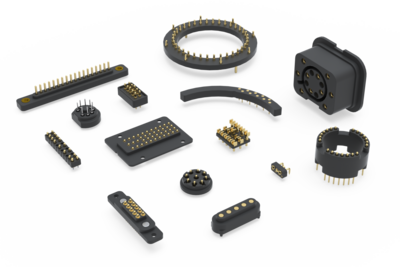
Custom connector solutions for prototype, low-volume, and production applications using injection molding, machined laminate insulators, and rapid 3D-printed prototypes. Whether you need a fine-pitch connector, a specialized insulator design, or a high-temperature interconnect solution, our in-house engineering and manufacturing teams can help bring your design to market faster. See Introduction to Mill-Max Custom Capabilities for the full range of what we customize.
Customize an Existing PartRequest a New Custom Part
Custom Manufacturing Approaches
Custom connectors are often required when standard components cannot meet specific mechanical, electrical, or environmental constraints. These requirements may include unique geometries, fine-pitch layouts, elevated temperature performance, or specialized assembly methods.
Mill-Max supports custom connector development through multiple in-house manufacturing processes, enabling engineers to evaluate, prototype, and produce application-specific interconnect solutions efficiently. By offering injection molding, machined laminate insulators, and additive manufacturing under one roof, Mill-Max enables a seamless transition from early design concepts to production-ready components.
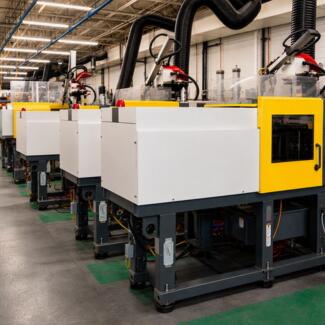
Injection-Molded Insulators
Injection molding supports high-volume, repeatable production of dimensionally consistent connector components. Engineered thermoplastics are injected into precision mold cavities to produce complex geometries while maintaining tight tolerance control.
Key Characteristics
- Supports complex connector shapes and geometries
- Produces consistent, dimensionally precise components with tight tolerances, supporting accurate fit and feature definition
- Provides uniform surface finish and consistent cosmetic quality
- Well suited for repeatable, large-volume production
- Compatible with a wide range of thermoplastic materials offering properties such as high-temperature performance, electrical insulation, mechanical strength, and chemical resistance
- High-temperature material options are compatible with RoHS soldering processes, including wave soldering, pin-in-paste reflow, and surface-mount reflow
Machined Laminate Insulators
Machined laminate insulators are commonly used for custom connector prototyping and low-to-mid-volume production, particularly when tooling is not required or when thermoset laminate materials are specified by the application. High-volume production is also supported when laminate materials are required for electrical, mechanical, or thermal performance reasons.
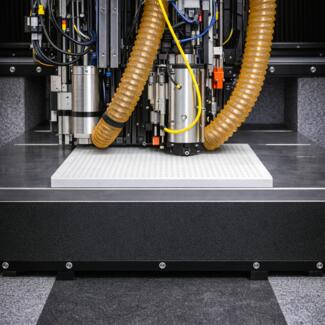
Mill-Max's in-house laminate milling capabilities enable the production of custom insulators without tooling, allowing design concepts to be evaluated and refined efficiently. Many standard Mill-Max machined components incorporate press-fit features, supporting direct assembly into laminate substrates and facilitating batch production.
Key Characteristics
- Supports prototype through high-volume connector designs with no tooling requirement, no minimum quantity
- Provides high positional accuracy in the X and Y axes for fine-pitch layouts, with Z-axis milling for steps, bosses, and pockets
- Allows integration of multiple machined components, including alignment pins, receptacles, threaded inserts, and carrier designs, within a single laminate insulator
- Available in material thicknesses from .031” to .500”, including the high-temperature FR-5, G-11 epoxy, and G-30 polyimide laminates
- Compatible with RoHS soldering processes, including wave soldering, pin-in-paste reflow, and surface-mount reflow
At Mill-Max, machined laminate insulators are the FR-4 custom connectors we mill in house. The terms are interchangeable: FR-4 is the laminate used most often, with FR-5, G-11 epoxy, and G-30 polyimide available where temperatures exceed its limits. Introduction to FR-4 Custom Connector Assemblies covers the design rules, material options, and assembly detail in full, and the Custom Capabilities FAQs cover minimum quantities and lead times.
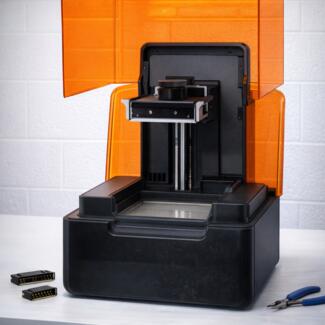
Additive Manufacturing (3D Printing)
Additive manufacturing, commonly referred to as 3D printing, supports rapid prototyping and early design iteration of complex connector geometries. This process is typically used to evaluate form, fit, and preliminary functional concepts prior to transitioning to production manufacturing methods.
Key Characteristics
- Enables rapid prototyping and accelerated design iteration
- Supports complex and customized connector geometries
- Used for form and fit evaluation prior to committing to injection molding or laminate machining
- Provides good dimensional accuracy for profile and positional assessment
- Printed housings can be assembled with machined pins to evaluate fit and alignment
- Reduces upfront tooling requirements during early development stages
- High-temperature and durable material options support functional evaluation under application-relevant mechanical and thermal conditions
Which Manufacturing Process Is Right for Your Application?
The right process usually follows from three things: how many parts you need, whether the design is still moving, and how soon you need them in hand. Injection molding earns its tooling cost once a design is settled and volumes are high. Machined laminate skips tooling entirely, which keeps prototypes cheap and leaves the design free to change, and it scales into production. 3D printing answers the earliest question of all, whether the part fits. The table below compares all three at a glance.
| Manufacturing Method | Choose It When | Volume | NRE Charge | Lead Time |
|---|---|---|---|---|
| Injection Molding |
| Medium to High (10,000 plus) | Yes | Moderate 10 to 16 weeks |
| Machined Laminate |
| Low to High | No | Short 5 to 6 weeks |
| 3D Printing |
| Samples* | No | Rapid 2 to 3 weeks |
- Lead times are typical and vary with the complexity of the part. Custom products overall run 5 to 16 weeks depending on the application. Contact us for a firm date on your design.
- * Samples may be available depending on the design of your insulator and the specifics of your application. Please contact our Technical Services team for more information.
Applications
Custom connector manufacturing approaches are commonly applied in industries where connector performance, dimensional accuracy, and long-term reliability are critical design requirements, including:
- Robotics and automation systems
- Medical devices
- Aerospace and defense electronics
- Industrial control equipment
- Consumer electronics
Custom connector manufacturing enables engineers to address unique interconnect challenges that cannot be solved with standard components. By combining injection molding, machined laminate insulators, and additive manufacturing, Mill-Max supports custom designs across the full development lifecycle, from concept validation to production deployment.
Why Engineers Choose Mill-Max
- Precision interconnect manufacturing since 1971
- In-house machining, molding, and assembly capabilities
- High reliability insulator materials to choose from
- In-house connector assembly and tape & reel packaging capabilities
- Rapid prototyping support
- Custom configurations based on proven Mill-Max components
- Engineering support throughout development and production
Next sectionFR-4 Custom Connector Assemblies: how in-house FR-4 milling delivers custom, low-quantity connectors without NRE tooling charges.
Not sure which process your program calls for?
Injection molding, machined laminate, and 3D printing each answer a different combination of volume, tooling budget, material, and timeline. Send us your requirements on the custom part worksheet and our engineering team will recommend the approach best suited to your application, along with the path from prototype validation to production deployment.
Request a New Custom PartCustomize an Existing PartContact Technical Services